European Court Holds Russia Responsible for MH17 Tragedy and Human Rights Violations in Ukraine
 Daily Updates News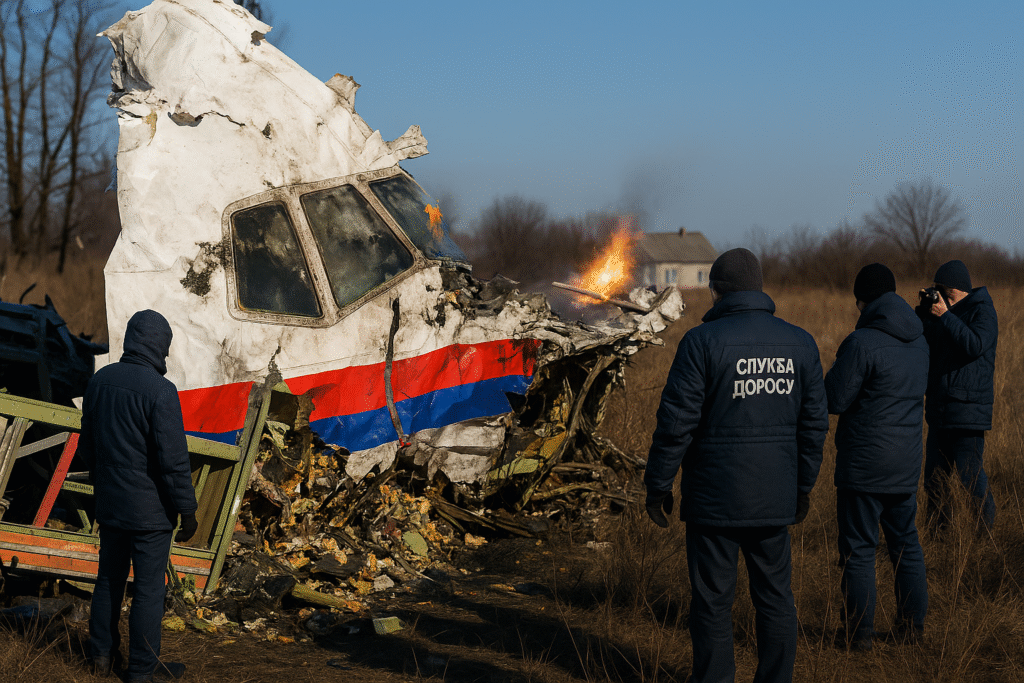
Investigators at the crash site of Malaysia Airlines Flight MH17 in eastern Ukraine, where the wreckage of the downed aircraft lies scattered in a deserted field.
July 10, 2025 | Global Affairs Desk
In a landmark ruling, Europe’s top human rights court has officially held Russia responsible for the downing of Malaysia Airlines Flight MH17 in 2014, an incident that claimed the lives of 298 innocent people. The judgment, delivered on Wednesday by the European Court of Human Rights (ECHR) in Strasbourg, also included strong findings against Russia for multiple human rights violations committed during its military operations in Ukraine.
The long-awaited decision marks a significant moment in international legal history and underscores the global community’s ongoing demand for accountability in the face of war crimes and atrocities.
The MH17 Tragedy: A Shocking Act of Violence
On July 17, 2014, Malaysia Airlines Flight MH17, a Boeing 777 traveling from Amsterdam to Kuala Lumpur, was shot down while flying over eastern Ukraine. All 283 passengers and 15 crew members aboard the aircraft perished. Investigations later confirmed that the plane was struck by a Buk surface-to-air missile, a Russian-made weapon fired from territory held by separatist rebels allied with Moscow.
For years, families of the victims and governments around the world have called for justice, while Russia has consistently denied any involvement in the disaster. The latest judgment from the ECHR is a decisive step in formally recognizing Russia’s responsibility for the attack.
Reading the verdict, the court’s president, Mattias Guyomar, stated, “The evidence indicates that the missile was intentionally launched at Flight MH17, likely under the mistaken belief that it was a military aircraft.”
The court further criticized Moscow’s refusal to cooperate with international investigations, noting that Russia’s actions significantly worsened the suffering of the victims’ families by obstructing justice and denying accountability.
Additional Rulings: Atrocities in Ukraine
The ECHR’s ruling extended beyond the MH17 case, addressing multiple human rights abuses attributed to Russian forces in Ukraine. These included acts of murder, torture, rape, and the destruction of civilian infrastructure following Moscow’s full-scale invasion in 2022.
The court found overwhelming evidence that Russian forces engaged in widespread attacks against civilian populations, resulting in the deaths and injuries of thousands. French judge Mattias Guyomar declared, “These acts violated international humanitarian law and were intended to create fear, terror, and psychological trauma among Ukrainian civilians.”
Particularly alarming was the court’s finding on the systematic use of sexual violence, including rape, as a weapon of war. “The deliberate use of sexual assault as a means to break civilian morale is an act of extreme brutality, amounting to torture,” the judgment noted.
The court also condemned the abduction of Ukrainian children and their illegal relocation to Russian-controlled areas, a practice that has drawn international outrage.
Russia’s Reaction: Dismissal and Defiance
As expected, the Kremlin swiftly rejected the court’s findings. Kremlin spokesman Dmitry Peskov told reporters, “We do not recognize this judgment. It holds no legal value for us and is considered void.”
Russia’s refusal to engage in the ECHR’s proceedings was also criticized within the court’s 501-page decision, which highlighted Moscow’s continued disregard for international human rights standards.
Although Russia was expelled from the Council of Europe in 2022 following its invasion of Ukraine, the ECHR still retains jurisdiction over cases dating back to before the expulsion. Legally, Russia remains obligated to respect the judgments of the court — though it has made clear it intends to ignore them.
Ukraine’s Response: A Legal Victory Amid Conflict
In sharp contrast, Ukraine hailed the ruling as a significant and historic development. Ukrainian officials described the verdict as an “undeniable victory” for their country and the families of the victims of Russian aggression.
Speaking to local media, a representative from Ukraine’s foreign ministry stated, “This is a moment of truth for justice and international law. The court’s acknowledgment of Russia’s crimes gives a voice to the victims and sends a clear message that such atrocities will not go unpunished.”
Ukraine also called on other international institutions to take note of the court’s findings and strengthen efforts to hold Russian officials and military commanders accountable for crimes committed during the conflict.
About the ECHR and What Comes Next
The European Court of Human Rights, based in Strasbourg, France, is one of the continent’s most important legal bodies tasked with upholding human rights and democratic freedoms. Despite Russia’s expulsion from the Council of Europe, the court continues to process cases involving the country for incidents that occurred prior to its removal.
While the ECHR will determine the amount of financial compensation owed to victims and affected states at a later stage, there’s little expectation that Russia will honor these rulings. Nevertheless, the judgment carries significant symbolic and moral weight within the international community.
As the war in Ukraine rages on, Wednesday’s decision serves as a powerful reminder that even in times of conflict, the world’s legal institutions remain committed to justice and accountability.